By Karl Anderson
This article first appeared in Marlin Magazine October 2024.
When we talk about technology in sport fishing the natural first thoughts are to look at the bridge and the electronics suites. In recent years there has been some great technology added to the bridge such as omni-sonar, which has been around for years in various commercial fishing industries, especially the commercial tuna boats.
Over twenty some odd years ago I had search light sonar which was an incredible tool. At the time, transducers for omni-sonars where prohibitive for sportfishing boat applications, thanks to the technology advances by engineers, that is no longer the case today. In todays world, without sonar you simply can not compete when it comes to tournament fishing, It has changed the game entirely.
Night vision technologies from Flir and Sionix are continually improving along with radar and overlay on multifunction chartplotting displays and then there is Starlink. An incredible game changer for communication and entertainment systems, 24/7 contact anywhere around the globe and for those of us that love to travel — what a great tool it is.
However, anyone worth his salt that runs a sportfishing boat knows that the care, maintenance and the ability to repair systems while in remote locations is paramount to a smooth trip. When companies invest to invent or improve or integrate new technology into their product, it generally is a great improvement to the boat and the operation. Keeping systems fresh, updated and running smoothy requires attention and preventative measures to achieve and sustain peak performance. Several companies have really raised the bar for boat operations and we can only hope that they continue to invest in new innovative products and improve and update their current ones.
SpotZero
Recently there have been several great game changers and they are beneficial to the boats health. One of the biggest things we fought was the water quality of the dock water, not only at home, where according to the engineers at Spot Zero, our good water still contains over 500ppm of dissolved solids. Meaning, for every milligram of water there are 500 pieces of organic material, minerals and chemicals in that milligram spot of water.
This is why we had issues, especially in places like the Bahamas and Mexico. As the folks at SpotZero explain it, the high contaminant content is basically a “microscopic rubbing compound” that is terribly abusive to the exterior surfaces, not just paint or gelcoat but metal, glass — all of it. Constant waxing along with soaping and a good chamois at the end of the day were mandatory to help us reduce the foul impacts of dirty water. Frequent vinegar washings helped reduce the spotting from the salt deposits that accumulated after the days wash down, even a after a thorough chamoising.
Then, along comes SpotZero systems who have had an incredible impact on the well-being of the boats exterior finishes. Their innovative and compact solutions for onboard combination water maker/purifiers and portable situations are a required tool for the boats overall care. Much like a Starlink, the Spot Zero systems are a given necessity for today’s new builds while traveling to foreign ports. Responsible owners and captains are adapting them into their travel packs if they cannot retrofit into the boat and then upon returning home, they integrate them into their home dock water system as well.
These mobile units known the Mobile Pro for boats from 40 to 85-feet and the Mobile Pro Mini for boats up to 45-feet are showing up on docks all over the world. Designed for robust and lasting performance the units are constructed with a corrosion resistant uni-body anodized aluminum frame with all internal plumbing creating a small footprint. With built-in maintenance technology to track membrane hours all displayed on an LCD touchscreen Easy end plate removal allows for quick and simple membrane replacement. If you cant fit a permanent unit in the engine or pump room, these mobile units are ready to go anywhere from Cabo to Cape Verde.
ElectroSea
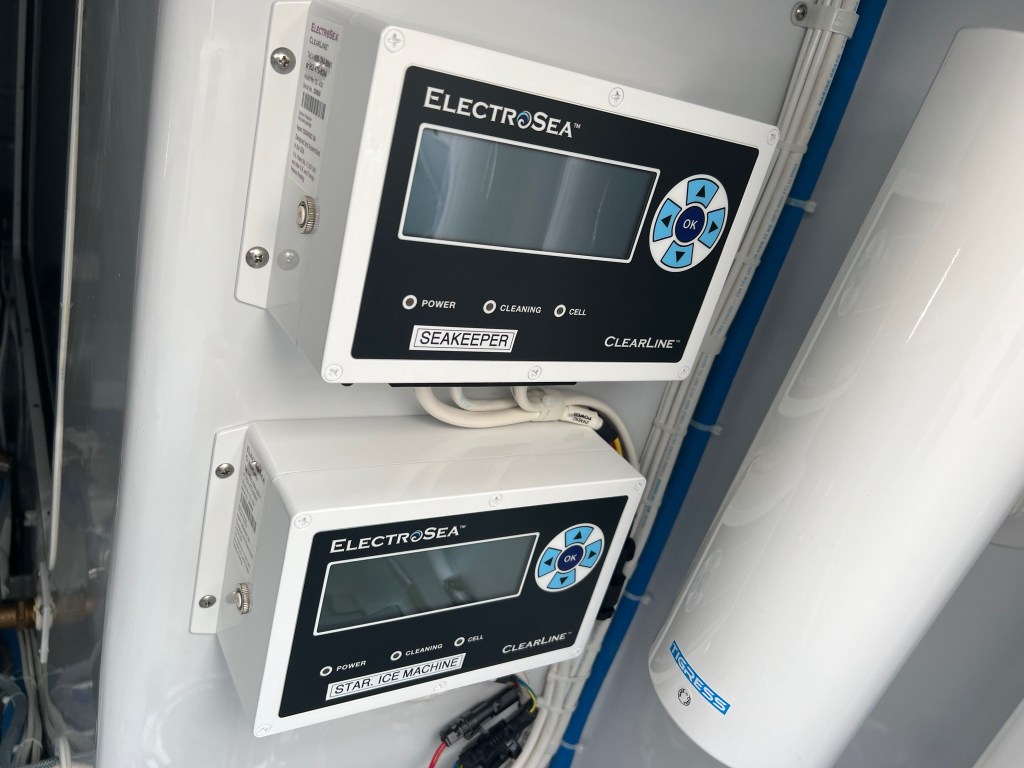
There has always been one incessant absolute pain-in-the-ass on every boat with continual raw water flow. That problem is organic growth and biofouling in sea chests, strainers, air conditioning systems and the like. Sea growth will reduce AC and refrigeration cooling system efficiency as well as clog drain lines and internal piping. It’s well-known necessity is the mother of invention. It took a seasoned boater and fisherman with immense knowledge in medical technologies involving liquid chemical sterilants and hollow fiber filtration among others to solve this age old problem. Founded in 2017, ElectroSea introduced the ClearLine® System and from there has never looked back on continual product development with seal-less pumps and growth prevention systems.
Today, the ElectroStrainer Pro combines all the elements necessary for integration into the boats raw water systems. Developed and manufactured for the rigors of the salt water environment, the Pro features specialized metallurgy in a no-weld, cast one-piece canister made with what is known as super duplex 2205 stainless steel alloy, noted for its strength and corrosion resistance. Inside the canister is a “hydrodynamical optimized” strainer basket deigned to strain debris and to diffuse the chlorinated water that is created by the “biofouling prevention device”. This device utilizes “advanced electrochlorination” technology that creates chlorine in low levels with incoming seawater making life for barnacles and other marine growth unsustainable.
The other beauty of this system is that it also has a control head integral to the unit that features and LED screen as a user interface giving the user an easy way to check the system. An integral ultrasonic “ClearVis® Flow Sensor” monitors the amount of effective raw water being run through the system constantly. The ElectroStrainer Pro alerts the user if and when the strainer basket needs attention.
Basically, as raw water comes into the boat to feed your systems, the electrochlorinaton puts enough safe amounts of chlorine, similar to what is in our drinking water, into its strainer basket and as water is treated in the basket and then distributed through the boats systems, it creates a growth free environment for raw water to do its job — efficiently cooling systems.
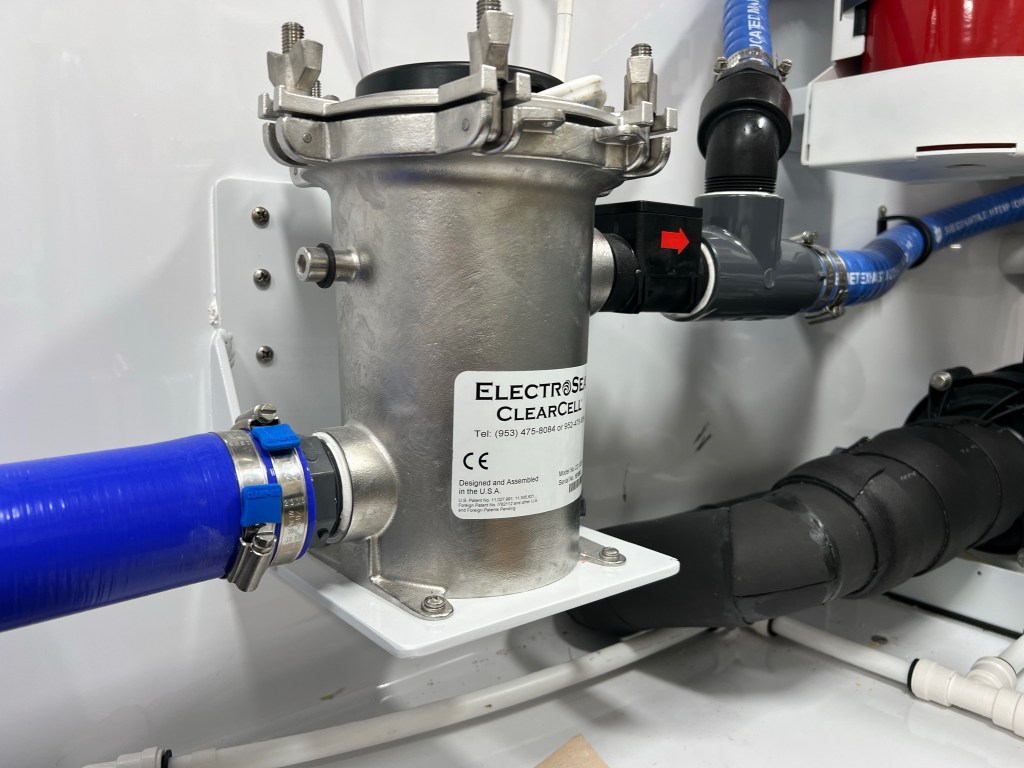
The ElectroStraner Pro units are available in four inlet/outlet sizes, 1”, 1.25”, 1.50”, and 2-inch with different incoming flow rates. On today’s large sportfishing platforms, more than one unit may be needed to service all the boats incoming raw water needs, especially when you consider the massive requirements for chilled water air conditioning systems, refrigeration systems, livewell systems and a host of other incoming raw water systems. Retrofit integration into any boat should be possible with the compact and simple design of the units. If you are tired of routinely having to clean your sea strainers, having to snake your outfall pipes, acid clean your AC and refrigeration systems every couple of months or weeks, you need to look into this time and money saving technology.
Safety Technology
I get to go on many different boat and and I see allot if things. I also see folks going farther and farther offshore, not necessarily in large sportfishing boats. I see and hear of allot of unnecessary issues when it comes to safety equipment and preparedness. Don’t want to preach, but we all know things happen at the least convenient time and hardly ever in good conditions. My crew and I take our safety and our guests safety very seriously, but even the most prepared crew and boat can have serious problems. The only thing we can do is be proactive to mitigate as many unpredictable situations as we can and remain calm, cool and collected when they do arise by having a solid and known plan.
One of the greatest assets to our safety today is satellite communications. I’m not talking about Starlink and SatComm, although they are a huge asset to have aboard, I’m talking about the personal connectivity safety equipment we now have. So many companies have great, reasonably priced solutions for your safety at sea, hunting, hiking or any remote outdoor activity. However for the offshore fisherman there is no excuse to not take advantage of the technology available for help on the water.
On the big boats and on our personal boat we have technology products on the ready and they are checked and updated annually as needed. I’m a ditch bag fan. I like having an EPIRB all the associate gear necessary, lights, strobes, mirror, whistle, flares both electrical and pyrotechnical.
The new ACR GlobalFix® V5 AIS EPIRB with Return Link Service and Mobile app is the top of the line in EPRIB safety, worth every penny for the far offshore or global sportfisherman. One of the things we see most is after purchase the EPIRB is forgotten and usually out of date with dead batteries.
Now with the A5 and smartphone connectivity monitoring and updating your EPRIB is super easy. You simply put your mobile phone next to the unit, this opens the ACR Product App. This app then opens a world of information on the Beacon status including battery life, the number of GNSS and self tests it has self completed as well the amount of time the EPIRB has been active since purchase. GNSS self tests are seen on a pinpoint map as to where they were completed, time and date of the set, length of time to obtain a fix, the number of satellites needed to get the fix and its accuracy. This connectivity allows the user to confirm the the status and ensure the EPIRB is working.
Return Link Service is the confirmation to whomever has triggered the EPIRB that the distress message has actually been received. Utilizing the Galileo Satellite Network, the RLS confirms the relayed distress message and the precise location and identifiers of the beacon have been received. A flashing blue light on the top of the unit confirms the RLS from the satellite network. Knowing your distress message and position has been confirmed is huge in a bad situation.
No matter where you are in the world, and some of us find ourselves in fairly remote places with no Coast Guard coverage, the A5 attains is signal and position accurately through GPS, Galileo or Glonass networks. Once activated the unit will transmit distress signals and your position with accuracy to within 100-meters to the worldwide Copses Sarsat search and rescue satellite network. The AIS signal is also activated to transmit to nearby vessels with AIS, so ships and other boats within VHF AIS reception will see your distress call and hopefully react to potentially reduce rescue time dramatically before the search and rescue operations can be mustered into activation.
LIferaft technology has dramatically improved. Performing research for the best quality and type for your application is recommended. Having the practical knowledge of how they work and how to deploy them is part of the preparedness the crew and guests should be capable of doing. Find or buy an out of date unit and deploy it. Utilizing your swimming pool or near dock waters is a great way to see how to get in the raft and if you can even get in the raft you have. Not all rafts are created equal. Annual inspection of your liferaft, EPRIB and all safety gear is a necessity. If you get put in the water, which its the last possible scenario after all exercises to save the vessel are exhausted, you should have the best raft and PFD’s available with lights for night rescue. Its an easy question to answer, what’s you life worth?
The good news is we have all types of technology that can improve our overall experience while aboard and to keep us safe. Sometimes we focus too much on the latest updated or new piece of electronics, tackle or fish catching gizmo and we overlook the things that can help make our jobs easier as crew and offer our owners and guests a better onboard and ownership experience.
 Capt. Karl Anderson