
Carrying or towing a tender is becoming increasingly more popular as it opens up endless opportunities to explore new territory, fish expansive areas inaccessible for the big boat and allows you to take advantage of lousy weather. With the right equipment set up correctly for easy use, having a tender or two makes every trip more fun for everyone. I’ve watched allot of sportfishing crews fish themselves out of jobs over the years by grinding out the offshore deep water fishing day after day and wearing their guests out. It’s a shame because opening up horizons and making the offbeat things available to guests that a shallow water skiff or a center console offer can fill up a trip and be allot of fun. Entertainment and fun are just a couple of the keys to longevity on the job.
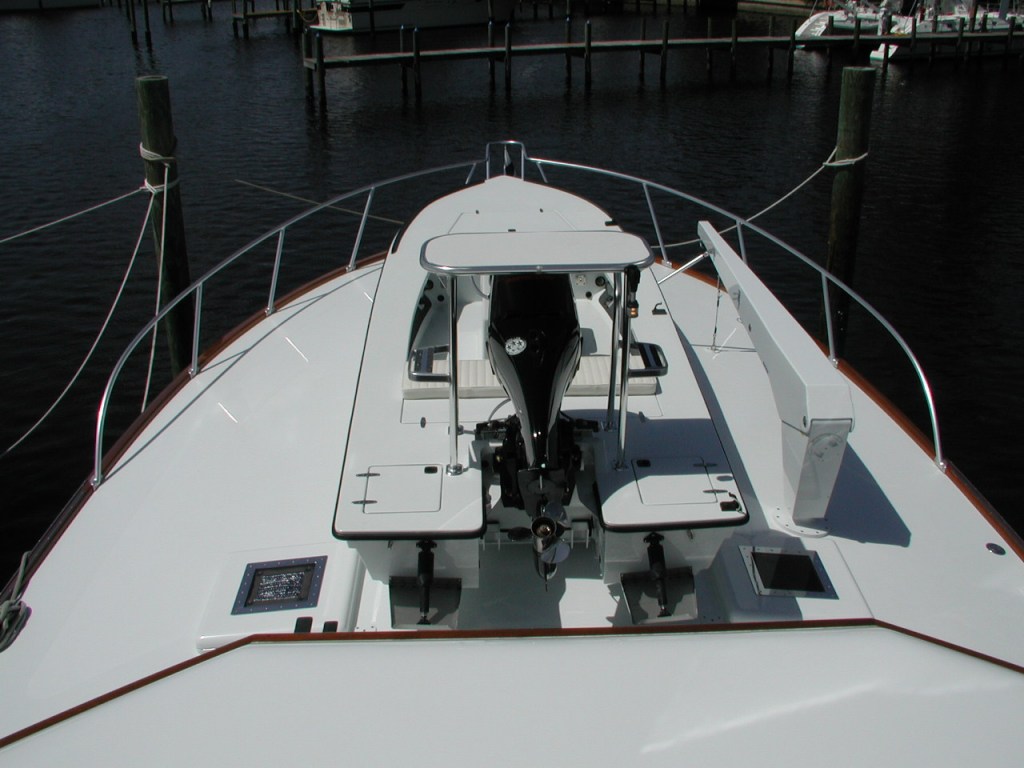
Selecting the right skiff or center console and then having them set up correctly with the right gear to tow them or lift and cradle them on deck makes life easier and more likely for these tools to be used. We’ve been carrying a skiff on deck for over 15 years and towing a center console for nearly half of that. There is no doubt having those tools has enriched our guests experience and absolutely enhanced our fishing. We have used both boats to catch fresh bait, scout, fish from, get supplies, snorkel, go to dinner or lunch, it’s endless what can be done, even giving those that don’t want to fish on the big boat an outlet for a days entertainment.
When it comes to selecting the right boat for the bow, many folks tell me they pick a rigid inflatable because when it hits the big boat it doesn’t do damage. Rubber boats are one dimensional, they are hard to get into when snorkeling, have no livewells for transporting bait, have a super high profile on the bow, don’t hold as many people or as much gear in the same footprint and in general are homely looking, and surely don’t fish as well as a proper skiff. So if your sole requirement is that you don’t do damage when you hit the big boat, you need to learn how to drive.
When it comes to a skiff for the bow, we have found that a flats skiff is most versatile. It has fishing features built-in, has a low profile on the bow and mainly opens up the entire world of inshore and shallow water fishing opportunities that are available where the big boat goes. The most important factor for selecting a tender of any kind is weight and if anyone says weight doesn’t matter, they really have no idea what it’s like to carry a boat on the bow.
Most manufacturers publish weighs that are just plain deceptive, don’t just take their word for it. The only way to really know what a boat weighs is to weigh it yourself and if the builder can’t weigh it for you, then they don’t know what the boat really weighs so how can they publish a boats weight? The weight is critical because it impacts what size davit and cradle is needed, what gauge lifting gear is needed and how the weight on the bow will affect the big boat as well as if the big boat foredeck may require a bit more structural reinforcement to support the added load.
Once you’ve made your decision, mounting the boat is a bit of a project that needs to be planned and done correctly. The cradles should be form-fitting to the skiff’s hull to help reduce movement in rough seas. Flat cradles allow the boat to shift, no matter how tight your tie downs are. This usually happens when you least need it to, when it’s rough. The cradles need to be bolted to deck plates that are thru-bolted on the deck with backing plates on the underside of the foredeck and the tie down eye bolts also need to be secured with backing plates. This requires dropping the headliner to access the ceiling of the foredeck.
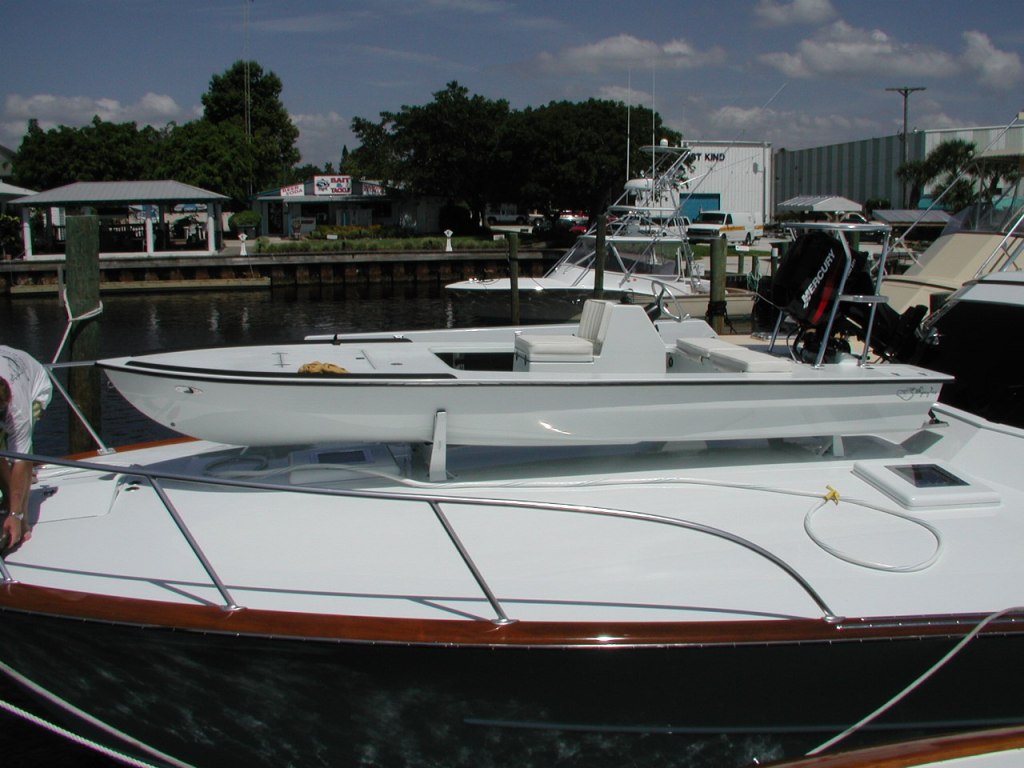
We use the flush deck plates so that we can remove the cradles if we take the skiff off the boat and clear the deck for an extended period such as our winter sailfish season in Florida. When selecting a davit, obviously lifting capacity and where the stand pipe will fit inside the boat are the primary criteria, then it gets down to the nitty gritty of self contained or remote mounted hydraulics, manual vs. hydraulic rotation, price and delivery dates.
Towing a center console behind a big center console or yacht for a tender is a great way to keep folks entertained at your destination. A good center console offers room for several guests, shade from a T-Top, fish boxes, livewells, dry storage, sometimes a head, fishability and easy in and out for diving and beaching. This is a great option for those that may not want to fish but can fill a day with sight seeing, inshore fishing, snorkeling, spearfishing, shelling, you name it, what we call “tropical tours” have saved many a trip.
Once you determine the size of the boat you would like to tow, you need to be sure you can tow it safely with the big boat. Be sure the cleats on the big boat are thru-bolted with substantial backing plates to hold the stress and strain of the towed boat. Towing a boat puts many opposing forces on the big boat when it’s rough. Knowing the big boats limitations are key to having a trouble free tow. Having the proper tow eye on the boat being towed is also very important.
Most tow eyes have an eye that you put the pin of a shackle through, putting all the stress of the tow on that pin. I have seen plenty of pins bent and mangled and some so bad they had to be cut off to disconnect the shackle from the boat. We use a much better and easier on-the-tow set up with a tow bit that has a round stock stainless bar that is bent and welded to the hull plates. This bar allows the shackle from the tow line to swivel on the bar so when the boat digs or veers off the pressure is equally distributed on the shackle and the tow bit, much like the links of a chain.
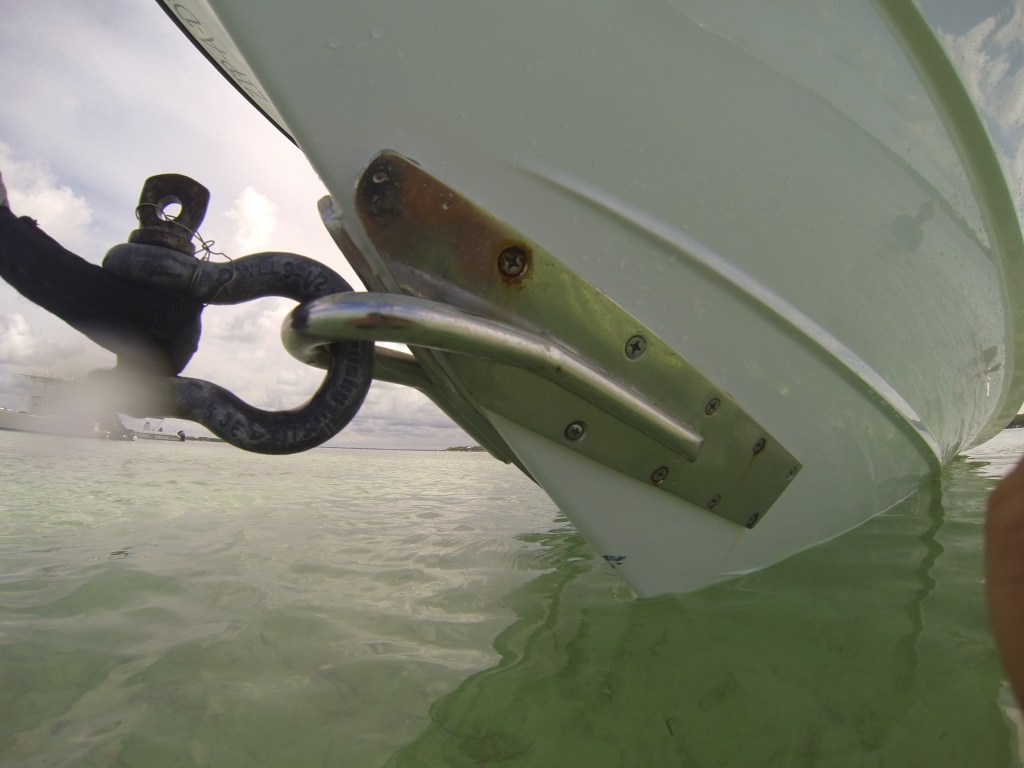
It is also critical to use backing plates and thru-bolts for the tow bit and be certain the stainless outer hull plates are large enough to distribute the loads across an area of the bow at or slightly above the waterline for the best tow. Having the tow bit too high can make the boat bow steer and pull hard when it needs to slide along with as little drag as possible behind the big boat.
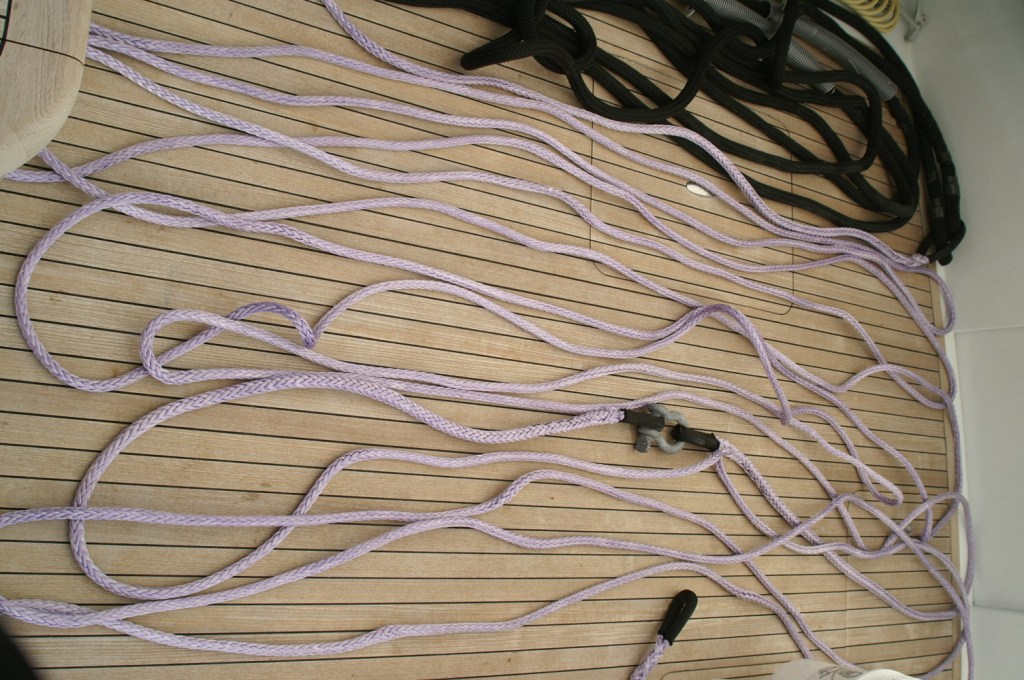
The tow line is not a piece of gear you want to skimp on. Insurance requires that if you are going to tow, you need to have your tow line surveyed annually by an accredited marine surveyor. We had our towline made by the folks at National Marine Supply in Ft. Lauderdale. For the main line, we used a 12-strand plasma line 5/8″ x 100 feet with soft eyes and chafe gear sewn on both ends having a tensile strength of 51,400 pounds. The plasma line reduces stretch and decreases drag, while from the boat we have a pair of 60-foot lines made of double braid nylon 1-1/8” with a soft eye and chafe gear on one end that make a bridle to the main line with the towboat ends whipped and left open for easier adjustment onboard the towboat.
In order to quickly disconnect from the towline we have a twelve foot piece of the 5/8” plasma that serves as a connecting line to the boat with an eye and shackle at each end. We leave it connected at the waterline tow eye attached and undo the shackle to the main line, the painter connecting line has a 15 foot length of ½” black double braid to pull in the shackle at the connecting line/main line join so it can be disconnected and easily brought to the skiff.
We use 7/8” Crosby G-209A Alloy Galvanized shackles as they are stronger than stainless steel shackles with a weight lifting limit of 9.5 tons. We carry spare shackles and pins for each connection in the event one is dropped overboard when making the transfer. We use monel wire to secure the pin to the shackles so that they do not unwind and vibrate loose in transit. We use Tigerflex hose as chafe gear where our harness lines come through the transom hawse pipes to the cleats to prevent wear on the harness lines.
Having one or both tender set ups will make a huge difference in your operation. The flexibility, opportunities and fun that they can provide will keep your guests occupied and smiling when the fishing is slow, weather is not cooperating or you have a big crowd with several agendas. Give it try and you may just find that tropical tours help you get to new and better fishing grounds.
 Capt. Karl Anderson