
This Column first appears in Center Console Angler
Connecting a length of leader or a wind-on leader to the main line is an important part of setting up your gear properly. Used for all types of fishing situations, having the ability to connect a larger section of leader to the line class you are fishing offers many pluses including better chafe resistance, the ability to better control the fish alongside the boat as once the beginning of it is wound on the spool, the angler can increase drag to hold the fish without putting the added pressure on the lesser-test main line and perhaps exceeding its breaking strength. It also gives a crew member more to grab when bringing the fish alongside.
It is always a practical and good idea to use the I.G.F.A. rules for double line and leader as a guideline to lengths as well as if the fish of a lifetime comes along, it may be considered for a record. Using the template in the I.G.F.A. rules as a guideline will also help when and if you fish a tournament as typically any tournament worth fishing uses the I.G.F.A. rules as a base of competition to keep the playing field even among its competitors.
According to the I.G.F.A. rules, the double line is “measured from the start of the knot, braid, roll or splice making the double to the farthermost end of the knot, slice, snap, swivel or other device used for securing the trace, leader, line or hook to the double line.”
For saltwater species, in all line classed up to and including 20 lb. test, “the double line shall be limited to 15 feet. The combined length of the double line and leader shall not exceed 20 feet.” For line classes over 20 pound, the double line “shall be limited to 30 feet. The combined length of the double line and leader shall not exceed 40 feet.”
The I.G.F.A. also has standards for leader and they state “the length of the leader is the overall length including any lure, hook arrangement or other device.  The leader must be connected to the line with a snap, knot, splice, swivel or other device. Holding devices are prohibited. There are no regulations regarding the material or strength of the leader.”
For saltwater species, “In all line classes up to an including 20 lb. the leader shall be limited to 15 feet. The combined length of the double line and leader shall not exceed 20 feet.” For all line classes over 20 lb., “the leader shall be limited to 30 feet. The combined length of the double line and leader shall be limited to 40 feet”
Having a base to work from we can begin to build our double line to leader or wind-on system. There are three basic ways to join a mono leader to the main line, the first is to use a Bimini twist also known as a Bimini roll, (the “roll” referred to in the rules) and create a double line to then join the leader to the main line with an Albright knot. Over the years extensive testing has been done to prove the best knots for strength and breaking strain. For creating a double line, the Bimini or the Australian Platte knot, also known as the Aussie braid are the best for strength and durability. The most common knot being the Bimini, which is excellent for all line classes, while the braid is best applied to 80 and 130 lb tackle if used.
To tie a Bimini, you take the tag end of the line and create a loop bringing it back alongside the main line. The length of your loop will depend on how long or short your leaders will ultimately be, remembering the template for 20lb. line class and under, the combined length shall not exceed 20 feet. So if we have a 15-foot leader, our Bimini and double line cannot exceed 5 feet.
Holding the main line and tag end in one hand and the loop in the other, you then twist the loop end making the lines twist around each other 30 times, for any line class under 8lb. you should increase the number of twists. For example when we fish 2, 4 or 6 pound for sailfish and white marlin, we use as many as 60 twists to increase the length of the knot and spread the pressure out over a greater distance so that one strand does not cut into the other when pulled together.
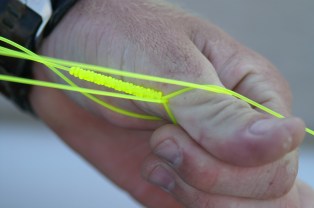
Once the twists have been made, you then put the loop on a reel handle or cleat and begin to separate the lines, forcing the twists to tighten against each other until you reach the point where the twists are tight and then begin to let the tag end roll down the twists to the point where the two sections are split. Take the tag end and make a single half hitch around one of the strands to lock the knot. Then put the strands together and make two more half hitches around both strands. To clean off the Bimini, you then make a half hitch that you pass the tag through twice, pull down to cinch the hitch and then trim the tag end off the knot. You then tie your section of leader to the double line with an Albright knot.
The next way to make the connection is to again, tie a double line with a Bimini in your main line. Then build what is referred to as a wind-on leader. Taking your mono leader material and a section of Dacron line, you serve the mono up into the Dacron several feet. The way Dacron is manufactured, you push it together to expand the core, then run the mono up inside the hollow Dacron and when you pull it, it tightens the core, so it works like Chinese finger cuffs, once the Dacron gets pulled on, the tighter it gets around the mono. You clean off the end of the Dacron where the mono runs into it with a series of half hitches for several inches over the Dacron down onto the mono using wax line or waxed dental floss.
On the other end of your Dacron you make a loop by serving the Dacron back up into itself several inches to create a loop. To serve the Dacron into itself, you take a 10 inch piece of number 6 or 7 fishing wire, bending it back against itself in the center and pulling one strand past the other to create a tight loop in the wire. Moving down the Dacron from its end, say 18 inches, you run the loop end of the wire tool into the side wall of the Dacron and push 10 inches of Dacron onto the wire tool and then push the tool out the side of the Dacron, putting the end of the Dacron into the wire loop and then drawing the wire tool back out of the Dacron until it comes out itself were you pushed it in the side of the Dacron to begin with. Adjust the loop and the Dacron to make a smooth loop transition.
You then marry the double line loop to the Dacron loop and your wind-on is connected to your main line. A swivel or snap is then connected to the mono end of your leader.
The third system of joining mono to mono is to use what we call a top-shot. When fishing with 30lb. or over we typically use Dacron backing and marry a mono top shot to that by serving the mono up inside the Dacron so we do not having to change out an entire spool of line, and we get the additional line capacity of the thinner diameter Dacron as opposed to using all mono. The top shot is typically a one hundred yard section of mono on top of the Dacron, hence the term “top-shot.”
When fishing day-in, day-out, with 20lb and under, we typically change our top-shots every several days or even more frequently when the action has been good, even daily when fishing tournaments. However, with 20 and under, we don’t use the Dacron backing, we simply cut back and add a new section of mono, and go loop to loop. Typically we change out between 100 and 150 yards of line by tying a Bimini in the line on the reel and one in the new section of line to be added. We then run the spool with the new line through the main line loop two times and bring the loops together evenly. This connection is then colored with a marker so that it is easy to see the next time you need to change out.
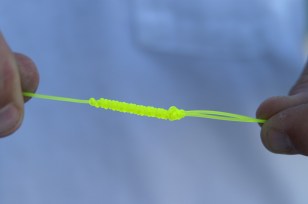
Practicing your Bimini is the key factor to marrying mono to mono, if you don’t know how to tie it, you need to learn it. It is the strongest, best knot for doubling line and going smoothly through the rod guides there is. And once you can tie it, you can marry sections of mono to your main line for all your fishing situations and increase you catch ratio because your connections are correct and you choose the leader material and size that best suits your needs.
 Capt. Karl Anderson